No. 8, Queen’s Terrace
The Early Years
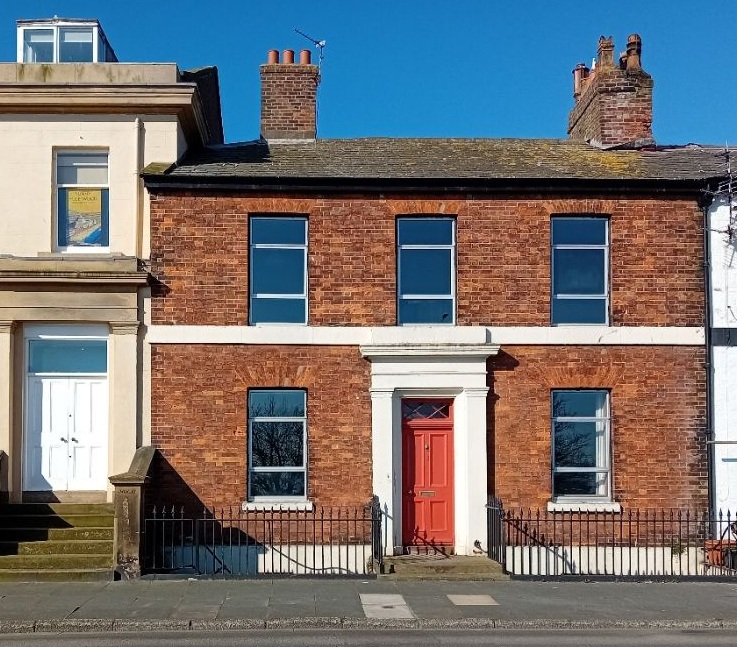
Which house is No. 8?
When the current No. 8 Queen’s Terrace was completed is unsure, but it was probably in 1839 near the opening of the Custom House. By 1845 it was No. 7, when it was the seventh property in the Terrace, the house to its left not having been built, with the Steamer Pub as both No. 1 and No. 2.
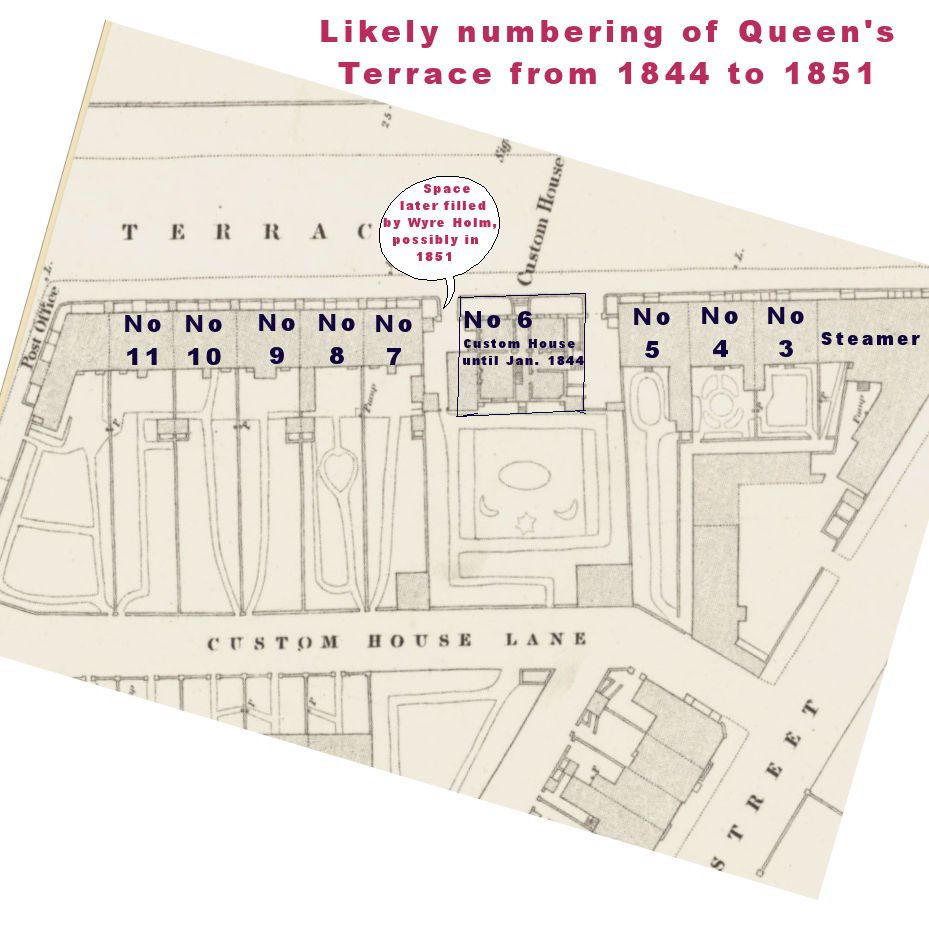
The house to the left of it (as seen from Queen’s Terrace), named Wyre Holm, was built in 1851, although two websites, including Wikipedia, mistakenly claim it was an 1876 extension to the old Custom House by Alexander Carson.
Having created street numbers for all the properties in the early 1840s, erecting Wyre Holm in 1851 messed this up . At times between 1851 and 1891, the original number 7 became number 6, number 9, back to 7 and, finally, number 8, as labelled in the 1891 census.
Because it had four different numbers, research of its occupants involved cross-referencing all available records with great care.
References marked “No. 8”, that is within inverted commas, refer to the property currently identified as No. 8, even though it had a different number at certain times.
1839-1851: The first known occupants
The property began life as a short-let, sometimes just during the summer months, sometimes outside that period, as at 1841.
Walter William Brooke appears to be the first known occupier, born in Essex in October 1815. His marriage in Clapham, in London, in October 1840 shows him living in Fleetwood as a surgeon. He and his wife were the probable tenants of the property in the June 1841 census, when he was again described as surgeon. However, between then and his death in 1891, he lived in London and was listed as an office clerk. There is no record of any formal medical training prior to 1840, when he was only 24. It seems likely that he was an apprentice-trained apothecary rather than a formal doctor of medicine, but he soon left Fleetwood.
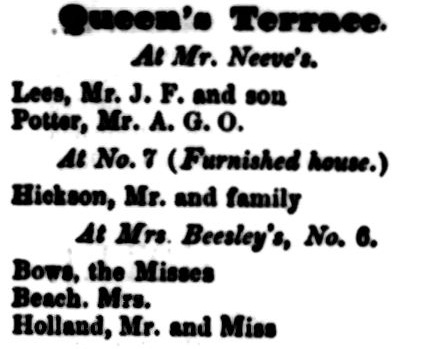
Moving to 19 July 1845, the Fleetwood Chronicle showed the house as furnished in this list of visitors. It was effectively a holiday let, but possibly had occasional tenants outside the season.
When the 1851 census was held, there was a building site to the house’s left . Wyre Holm was commissioned by Julian Tarner, who occupied “No. 8” (what was No. 7 at the time). He was an architect, inventor, and yachtsman, whose brother Edwin owned the valuable Tilbury Carriage Company. He was probably quite an important person in the town, and was unafraid to act the part.
Renting the house as a short-term let was probably a convenient way to oversee the construction of his new house.
Wyre Holm filled an original gap shown on the 1844 Ordnance Survey Town Map, between the old Custom House and “No. 8”.
1851-1862: A Lodging house, and special visitors
Julian Tarner left “No. 8” by the end of 1851, moving into his new property next door at Wyre Holm. The Mannex directory for the year showed a new occupant, Mrs. Mary Beesley, who had run the former Custom House as a lodging house and, before that, was housekeeper at Rossall Hall.
1861 saw special guests staying with Mrs. Beesley for two weeks at the end of August and beginning of September. The Fleetwood Chronicle listed Sir Hesketh and Lady Fleetwood and Mr. Hesketh Fleetwood, their son, as visitors, also reporting this:
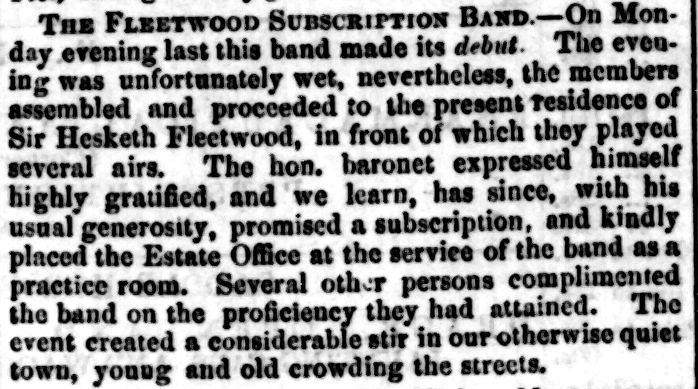
Fleetwood Chronicle 6 Sep 1861
The “present residence” was the lodging house of Sir Peter’s former housekeeper, Mary Beesley, “No. 8”. If the conclusions stated here are accepted, was this event on 1st September 1861 one of the most special in the history of the property?
The last known “visitors” to Mrs. Beesley, as reported in the Chronicle on 29th August 1862, were Captain and Mrs. Ibbotson and family, from Eccles. The Chronicle stopped reporting Fleetwood visitors from 1863, and we have little information from then on Mary. She died at Pilling Lane, on the other side of the Wyre, and was buried in Stalmine in 1867.
No records seem to have survived of the next occupants. No. 8 may have reverted to its earlier role as a seasonal letting, or it might have been occupied and let on a monthly basis for a few years.
1862-1869: A pause in the history
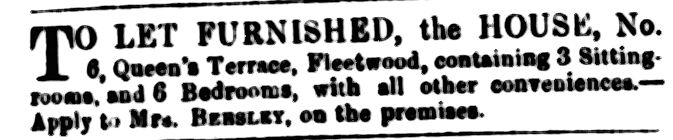
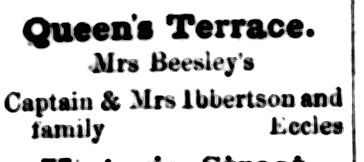
“No. 8”, although then numbered 6, was advertised to let on the 21st of March 1862. However, as the name “Mrs. Beesley” continued appearing in the visitors lists of the Fleetwood Chronicle as late as the 29th of August 1862, she seems to have run the lodging house for most of the 1862 holiday season. The last family was that of Captain Ibbertson. He may have been associated with the 4th dragoon guards, a Belfast regiment.
“No. 8” was still owned by Sir Peter, but both landlord and tenant passed away in the decade, Sir Peter in 1866 and Mary Beesley in 1867.
Sir Peter still held a number of properties in the Lower Terrace when he died, but the only one in the Upper Terrace was No. 13, the penultimate apartment before Pharos Street.
Sir Peter died aged 64 years on the 12th of April 1866 at No. 127 Piccadilly in London. His son, Peter Louis Hesketh-Fleetwood, was present at the death and registered it. Sir Peter had been ill for 6 weeks and died of a diseased liver.
Probate was granted initially on 6th June 1866 when death was proven by his widow, named as Dame Virginie Marie Hesketh-Fleetwood. It was granted again on 10th March 1879 by his son, whose death on the 2nd of April 1880 at Monte Carlo was proven by Virginie Marie Willis, Sir Peter’s widow having remarried, although her second husband sued her for divorce.
Returning to the probates for Sir Peter, they declared him as: –
“formerly of The Terrace Richmond in the County of Surrey but late of Fleetwood in the County Palatine of Lancaster and of 34 Adelaide-crescent Brighton in the County of Sussex.”
The limited accounts of Sir Peter’s life seem to have ignored the statement that he was late of Fleetwood.“ He seems to have occupied one of his Fleetwood properties, probably at 13 Upper Terrace.
There is little or no information on “No. 8” between 1862 and 1870, still numbered as 6. We have to pick up its history in January 1870.
1870: A new owner
The death of Sir Peter Hesketh Fleetwood in 1866 left his finances in a real mess. He owned several properties in Fleetwood plus freehold land on which there were many properties with long leases, but these had to be sold to cover the debts of his estate. He had:-
A) Underwritten the railway construction when its cost outweighed subscriptions from shareholders.
B) Gifted land to John Abel Smith’s ill-fated Fleetwood Tontine Company.
C) Seriously depleted his capital through his generosity and philanthropy.
On the last Friday and Saturday in January 1870, a two-day auction was finally held at the Crown Hotel. It was advertised over 5 editions of the Fleetwood Chronicle, with single inserts in several other papers to give it full coverage.
“No. 8” was then labelled No. 6 and was also lot 6. John Carter had already been renting it, but now purchased it with its freehold. The cost was £420, equivalent to £43,626 in January 2026 and a real bargain.
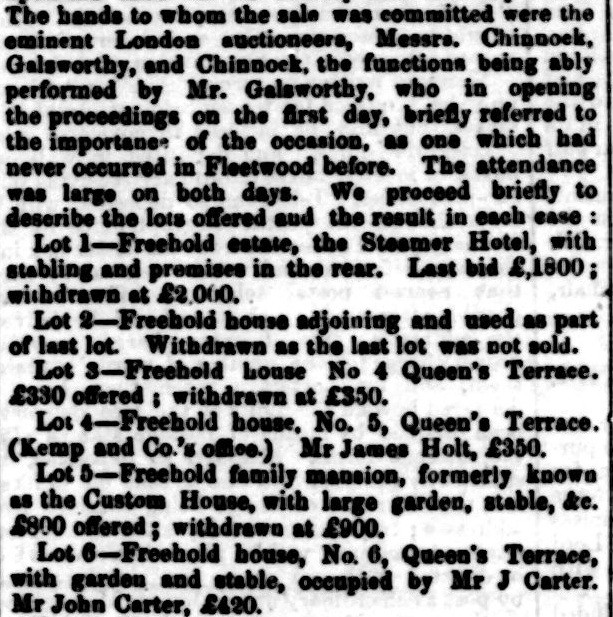
Fleetwood Chronicle, 4th February 1870
The next years for the house saw it revert to a family home for a considerable time. The Carter family was one of the house’s longest occupiers.
To read more about them and their long stay at “No. 8”, follow this link →.
1906 to 1920: The fruit merchant
Relying on census records, No. 8 was occupied by Thomas Stirzaker by 1911. He was a fruit wholesaler who was born around 1850 in Preston. He died on 26th September 1920, and his widow moved to Custom House Lane.
No. 8 was then bought as a police house.
1921-19??: The police house
The 1921 census reveals new occupants. For a number of years from then, the building housed police officers and their families. The first of these was William Thompson and we then know about Samuel Mitchell. 1931/2 voters at No. 8 were listed as James Walter Ormerod and Mary Alice Ormerod. James was a senior detective who retired in 1936, and presumably then left No. 8.
There are several references to No. 8 at the start of the second World War in 1939, firstly to its basement rather than to its main living area; the basement has its own entrance approached via iron steps leading down from the street. It was used as the base of Harry Stonestreet, the Chief Air Raid Warden, who lived somewhere on the Esplanade. It stored air raid equipment including gas masks. Air raid practices, including the detonation of a small anti-personnel explosive device on Custom House Lane, were conducted from there. This role continued throughout the war.
The next known occupant was Geoffrey Fletcher Shores, a young detective who arrived in Fleetwood in 1942. His wife gave birth to twins in 1944, and the son has passed on some notes on No. 8, including using the cellar where the gas masks were hanging with his twin sister as a playroom, and pointing out the importance of radio at the time.
The Shores family stayed in Fleetwood up until 1957, celebrating the Coronation of Queen Elizabeth the Second in 1953 at the Steamer Hotel with landlord, Frank Hill and his family.